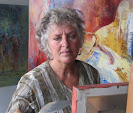
The Beijing Project

During the month of May I, Toos van Holstein, am artist in residence in the NY Arts Gallery Beijing in China. In this time I want to create in one of the big spaces of the gallery an exhibition of oil paintings of my hand. But as a part of the exhibition I also want to cooperate with several Chinese artists in creating a symbiosis between the Chinese modern art and the Western modern art. For this I have available 8 banners of 6 meter length on which already parts of paintings of mine have been printed. On these banners I want to work with the other artists in changing them in new art works that will hang down from the high ceiling in the gallery space.

About me

donderdag 15 mei 2008


What to do on a normal Beijing Thursday? Well, some work in the morning, then lunch in town with members of the Dutch Club here because it’s the third Thursday of the month (just information for the insiders), have a look in the neighbourhood of the restaurant where a big band of young children is receiving some very important person visiting their school and then of course to the Lama temple. Who did say something about diversity and contradictions?
The lunch was really nice, sitting outside and talking uncomplicated in Dutch to the ladies of working male expats in Beijing. I’m curious in which language I will dream tonight, Dutch or English. Because the last couple of nights English started to become dominating.
The young big band, fascinating to see these children play so well, sounded really good. At home I have heard bands of adults with less quality.

But the highlight of today was the Lama temple, the most important Tibetan Buddhist temple in town. Here the next reincarnation of the Panchen Lama used to be chosen. In the middle of Beijing amidst the high apartment buildings, new offices and the heavy traffic in the streets suddenly arises this centuries old complex representing a lot of history. Within the walls rules a benevolent quietness unless the many tourists, as well Chines as foreigners. I found it remarkable to see so many young Chinese offering and praying very concentrated.
Because usually one doesn’t speak to much about the recent past it was also remarkable to read on one of the official signs that due to Tsoe-En-Lai, the Prime Minister in that time, the temple had survived the Cultural Revolution and had been opened again to the public in 1981. More queer it was to read on the most important temple of the complex the other official remark that in 1990 the big 18 meter high Buddha inside, made out of one piece of sandalwood, had been mentioned in the Guinness Book of Records. How important this book can be! And how nice is it to show the ambience of the temple by a lot of pictures.


woensdag 14 mei 2008


Days fly by. I put a big table in the gallery space to experiment with water colour, Chinese ink and the different sort of paper I bought in the material shop near the Academy. But life is not work alone. So this afternoon we had lunch with Nan Fei, an artist I had contacted already via e-mail at home. After lunch she took us to a gallery lead by a French women married to a famous Chinese rock star and the studio of a Chinese artist who made huge paintings. That’s again such a question I’m wondering about. I have seen now so many real big paintings. Where are the walls to hang them, who is buying them?
But that’s not what I wanted to write about today. Today is showtime for our hutong restaurant, the one I mentioned already several times before. Simple but clean and delicious food. The best way to show this is of course by a lot of pictures.
The daughter or son is taking the orders, father wipes the floor and takes care of his grand child, mother keeps an eye on the bills, the money and puts rice from a big pan in the small cups and then there are two men in the kitchen. This kitchen looks very organised with only one disadvantage, the noise of a starting aeroplane that’s coming out of it when the gas is burning high under the pans for new plates ordered. But we don’t complain about that because we know how high, or better said low, the bill will be afterwards. And that the beer-machine is standing besides the dishwasher in the restaurant itself while the television is sometimes a bit too loud, well, who cares.
By the way, when we leave at the end of the month the restaurant will have one menu with English characters besides the Chinese ones. Each time we see an interesting dish on one of the tables we ask if we may have a look at it, ask where it is in the extensive menu and write the English translation to it. Isn’t that a good example of globalisation?


dinsdag 13 mei 2008


Hegezhuang is the name of the part of Beijing where we stay for this month. It’s pretty far from the centre of town but this doesn’t say anything in a big city like Beijing. It’s still just a bit country like but not too far away tall buildings are already visible which probably means that within a couple of years a lot of the ground around will be used for building houses, apartments, offices etc. Developments are going really fast here.

But let’s stick to Hegezhuang. In my view this area shows all what’s going on in the centre of town. The gallery where we live is part of a new build artist village. Four years ago nothing was here and now this so called 318 Art Garden is filled with studio’s where artists work and live. It’s simple and clean but not rich in its ambience (see photo). Therefore it’s so interesting that on one side of our enclave a very, very expensive teahouse, the Green T House, is found. Even an American guy we met last week in Frank’s Place (read about in the blog of May 8), who was a main stockholder in a world famous truck company, told us that his visit there had been a real rip off. So, imagine what it has to be to even the richer Chinese. But the building itself is beautiful (see photo) in all its white colour and the interior shows a kind of minimal Chinese design I have never seen before. May be they have to find their clients in the rich enclaves in our surroundings. High walls like the Great Wall hide the houses inside partly but it’s still visible that they are really big and the gates are pretty well guarded. Our taxi driver told that these houses could be bought for about € 800.000. For Chinese standards this is, I presume, a huge amount of money. Certainly when this is compared with the € 4 we have to pay in our restaurant in the hutong nearby for a delicious and extensive meal for four persons. Contradictions in Hegezhuang also are not far away as is of course the case in the whole of China nowadays.

If we walk from the gallery to our hutong, in the opposite direction from the Green T House, we pass another enclave for art. Here a lot of new galleries are build. In a huge old factory hall they already hanged a lot of art of Chinese artists living in the several art villages in and around Beijing (see photos). But about these art enclaves I would like to write another time. In my opinion all these contradictions in just this small piece of Beijing reflect what’s going on in society here. But I feel really happy about the fact that still this traditional hutong exists with its small shops, its food stalls in the streets (see photos) and its many friendly and happy people. Even when they don’t speak English.


maandag 12 mei 2008


Thirteen years ago we were in Beijing for the first time. Just before the first McDonalds had been opened there. Out of curiosity we of course had to bring a visit. It was interesting to see that the young and trendy Chinese in that time, who had a bit more money to spend than his average fellowman, saw a meal here as something really exiting.
Today we brought a visit to the same region of town but it could have been in another city on another planet. The only resemblance was that there were a lot of people looking Chinese. The view in Wangfujing Dajie, THE shopping street in Beijing, wasn’t different from other expensive and modern shopping places elsewhere in the world (see photo). It’s really unbelievable what has happened here in about 10 years. Reading about it is not enough, you just have to see it with your own eyes! On a big Olympic billboard ‘impossible is nothing’ could be read (see photo). Well, in this text nothing could be found that was not true in these surroundings! This presumably was even more true to the big groups of Chinese tourists from rural areas. They were recognisable by their white, yellow or white caps (photo) and the fact that they often walked behind a person with a small flag.

I found it striking to see a lot of billboards with only Western models (photo). But fortunately there was still this young innocent Chinese guard at the beginning of the mall as a token of decorum and consequence of the system. If you just would think the people away inside the malls(photo) you would know that you were in a very luxury surrounding, but where? That would be the question! But luckily there are those Chinese in the streets, sitting around, talking and eating. And don’t forget the bikes that are still there and the rather primitive cars of the people that keep the streets clean (see the different photos). Also the inevitable tramp had found his place (photo), but for how long? The Olympics are coming.


zondag 11 mei 2008

Today the opening at 3pm! And this morning at 5am the rain could be heard loud and clear on the roof and didn’t stop for hours. This doesn’t ease the nerves because rain usually isn’t much beneficial to a successful opening. But we had some luck, about one o’clock the sky became a bit clearer, the rain stopped and even the preparations for the barbecue in the garden of the gallery could start. So it became a lively happening with a lot of visitors. Among them also a number of foreigners, even some Dutchmen, and of course several curious Chinese artists. Let the pictures speak for themselves!